History
History of the Sinjeur Semeijnsstraat and surroundings
Our neighborhood has a rich history. To properly understand the current plans, it is important to see where we came from.
From grass fields to flats
In the 1950s and early 1960s, there were grass fields along Sinjeur Semeijnsstraat and Jephtastraat, with the two-lane Einsteinweg in between.
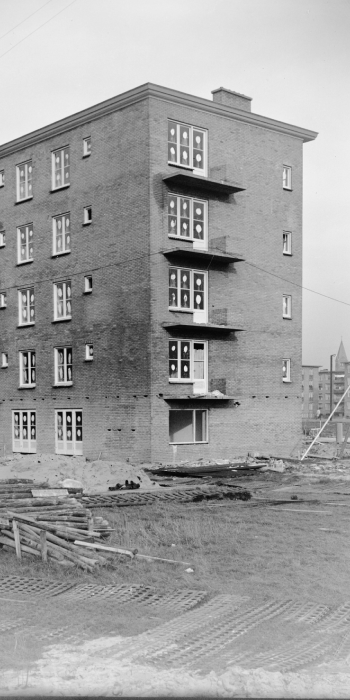
Between 1960 and 1963, the Max Havelaar flats were built here. A planning mistake: shortly afterwards it was decided that the Einsteinweg would be expanded into a 10-lane ring road (A10).
Because the flats were already there, the road literally had to be built over the homes. This created the infamous viaduct between the flats: a unique but unfortunate design that has burdened residents ever since with noise, fine dust, and a view of traffic.
A lesson from the past
The viaduct at the Max Havelaar flats is still seen today as a planning blunder. Residents, especially on the lower floors, live with traffic just a few meters away.
This shows what happens when building is done without respect for livability.
The Rhapsody complex
More recently, the Rhapsody complex was built along Leeuwendalersweg and the A10.
There, the choice was made for a “blind wall” on the highway side, mainly with corridors and storage rooms. That was an attempt to limit nuisance – but it is neither beautiful nor livable.
Why this is relevant now
History teaches us one thing: building right next to the highway is a mistake.
Yet Rochdale now threatens to make exactly the same mistake – 60 years later.
That’s why we say: learn from history, don’t repeat the mistake.